If you are evaluating resort development land in the Abaco Islands, the view is only the beginning. A beautiful waterfront parcel can still face title issues, utility constraints, coastal permitting hurdles, or subdivision requirements that materially affect timing and cost. This guide will help you focus on the factors that matter most so you can assess land more strategically and move forward with greater confidence. Let’s dive in.
Why Abaco Draws Resort Interest
Abaco stands out as one of The Bahamas’ most boating-oriented resort markets. The official tourism site describes the island chain as the country’s boating capital, notes that it stretches roughly 180 kilometers, and identifies Marsh Harbour as the commercial center with international airport access on Great Abaco and boat or ferry links to many outer cays. That combination supports a range of resort concepts tied to marina use, fly-in travel, and island-hopping experiences, according to The Bahamas tourism overview of the Abacos.
Visitor momentum also supports serious underwriting conversations. The Bahamas Ministry of Tourism, Investments & Aviation reported that The Bahamas welcomed 11.22 million visitors in 2024, with Abaco air arrivals up 11.9% year over year. In a January 2026 ministry update, Abaco was also reported to have set a 2025 record with just under 520,000 visitors, driven mainly by sea arrivals, as noted in the latest national tourism growth announcement.
Recent airlift is another practical signal. In June 2025, BMOTIA announced daily Fort Lauderdale to Marsh Harbour service via Aztec Airways, which adds meaningful connectivity for leisure and business travelers considering Abaco-bound trips, according to the Marsh Harbour air service announcement.
Start With Access and Demand
Before you model room keys, branded residences, or marina slips, look closely at how guests will actually reach the site. Abaco’s demand profile is shaped by both air and sea arrivals, and that matters because some parcels align better with boating traffic while others may work better for fly-in resort use.
A site near Marsh Harbour may benefit from proximity to the commercial hub, established marina activity, and stronger transportation links. Marsh Harbour is described as a full-service marina center and commercial hub, which can support a resort concept that depends on yachting access, provisioning, and ease of arrival.
In practical terms, your business plan should match how visitors use Abaco today. A highly access-dependent concept on a remote parcel may require more infrastructure and operational planning than an inland or better-connected site. That does not rule out outer-cay opportunities, but it does raise the importance of early feasibility work.
Confirm Title and Legal Access Early
One of the most important early screens is legal control of the parcel. Under the Planning and Subdivision Act, development applications can cover a wide range of items, including site plans, architectural designs, land-use plans, zoning amendments, minor variances, subdivisions, and severances, as outlined in the Planning and Subdivision Act.
That means land diligence is not just about location. It is also about whether the parcel can move cleanly through a real approval pathway. The planning forms call for review of title, restrictive covenants, easements, and existing site conditions, along with any required planning rationale or environmental study, based on the official planning application materials.
For resort land, clean access is especially important. If the property does not already benefit from direct public-road access or a workable access plan, the site may be less straightforward than it first appears. This is often one of the earliest issues that can affect value, timeline, and design flexibility.
Understand Subdivision and Infrastructure Requirements
If your resort vision includes multiple components such as villas, branded residences, staff areas, or phased development, subdivision rules deserve close attention. The Planning and Subdivision Act ties approvals to access roads or direct public-road access and to the provision of electricity, water, telephone, and other utilities.
The Act also states that no building can begin on a tract until markers are placed and roads are formed and graded. In other words, entitlement and physical servicing are closely linked. For a buyer evaluating development land, this is a reminder that raw acreage and buildable acreage are not always the same thing.
A useful way to assess a parcel is to ask:
- Does the site have legally reliable access?
- Can internal roads be formed efficiently?
- Can utility service be extended at a reasonable cost?
- Will the development need subdivision approvals to match the business plan?
These are not minor details. They can shape your land basis, phasing strategy, and construction timeline from the outset.
Screen Environmental Risk Up Front
In Abaco, environmental diligence should begin early, not after concept design. Under the Environmental Impact Assessment Regulations, a project cannot begin until a Certificate of Environmental Clearance is granted, and the relevant department determines whether an EIA, an EMP, or additional studies are required. Public consultation is also built into the process under the Environmental Impact Assessment Regulations.
The 2024 amendment expanded the definition of environmentally sensitive areas and increased penalties for noncompliance. For resort developers and land investors, that makes early screening even more important, especially on parcels with wetlands, shoreline features, marine interface, or other sensitive characteristics.
Abaco also includes important protected habitats. The Bahamas Ministry of Tourism highlights the 20,500-acre Abaco National Park as a key habitat area, while Black Sound Cay National Reserve near Green Turtle Cay is identified as a mangrove reserve important for bird habitat, as noted in this sustainability and ecotourism overview.
That does not mean nearby land cannot be developed. It does mean site selection should account for protected or sensitive natural features before you place too much confidence in a preliminary concept.
Treat Waterfront Parcels Differently
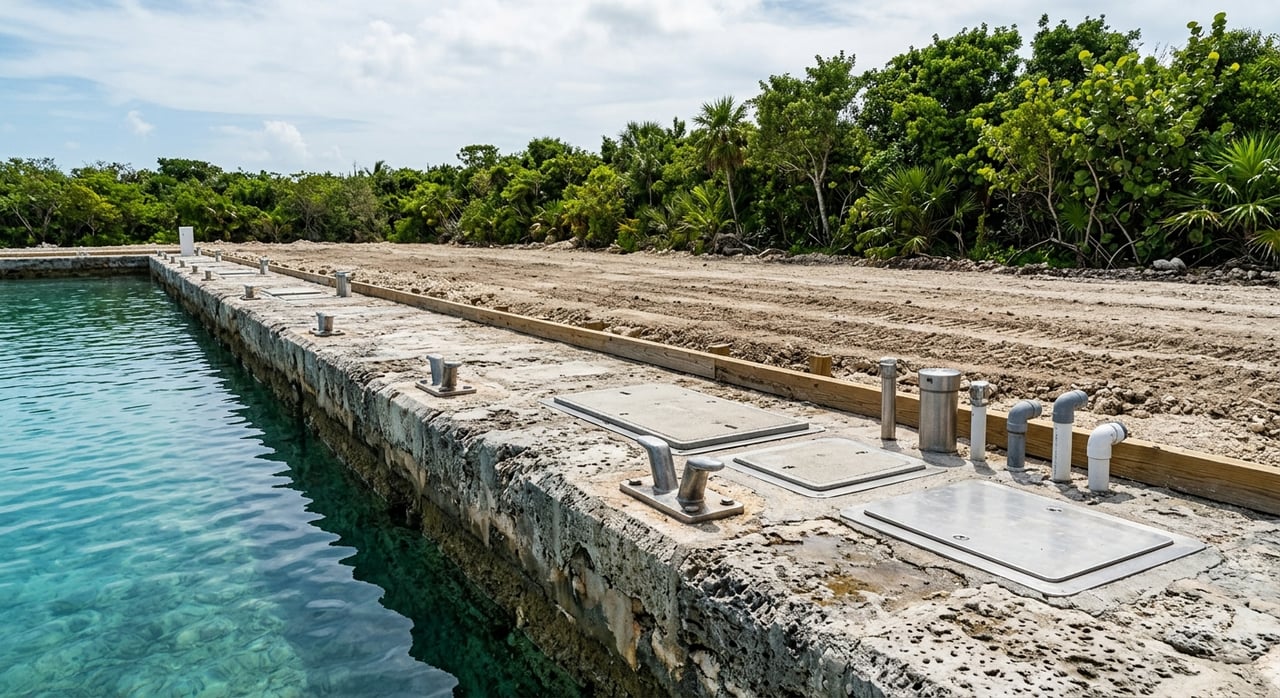
Waterfront resort land can be compelling in Abaco, especially for marina-oriented concepts, but it also calls for more careful diligence. If a parcel requires excavation, fill, canal work, a bulkhead, a pier, or other work affecting the coastline, the Physical Landscape Act requires a permit and may require an environmental assessment addressing wildlife habitat, topography, soil, vegetation, and historic features under the Physical Landscape Act.
This is one reason inland and waterfront parcels should not be evaluated in the same way. A marina concept may offer strong upside where coastal conditions and approvals align, but the diligence path is usually more layered. Early technical review can help you understand whether the waterfront premium is justified by the likely permitting and construction profile.
If your concept depends on docks, slips, or marine infrastructure, you should evaluate those requirements before treating the parcel as fully developable for that use. Timing and cost assumptions can shift quickly once coastal work enters the equation.
Verify Utilities Instead of Assuming Them
Utility availability can materially influence resort feasibility in the Abacos. The Water and Sewerage Corporation states that mainland Abaco communities are supplied with potable water, generally from groundwater resources, while some settlements rely on reverse osmosis. WSC’s Abaco office is in Marsh Harbour, with substations in Treasure Cay and Coopers Town, and its Abaco profile lists 2.1 million imperial gallons of daily production and 5,300 accounts, according to the Water and Sewerage Corporation.
That is helpful market context, but it is not a substitute for parcel-level diligence. You still need to determine whether service can actually be extended to the specific site, on what timeline, and at what cost. Utility capacity on paper and utility readiness on a development parcel are not always the same thing.
Power reliability should also be analyzed on a site-specific basis. Bahamas Power and Light reported in December 2025 that it had restored stable power across the Abacos after an extended outage originating at Wilson City Power Station, as detailed in this BPL service update. For resort planning, that is a practical reminder to consider backup generation and load testing as part of your feasibility model.
Match the Parcel to the Resort Concept
The best development parcels are not just attractive. They are aligned with a clear operating concept. In Abaco, a site should be evaluated through the lens of how guests arrive, how utilities will be delivered, whether marine access is central to the experience, and what approvals may be triggered by the land itself.
A strong early-stage review usually includes four core questions:
- Is title and legal access clear?
- Can water, power, and other services be delivered reliably?
- Will wetlands, shoreline conditions, or marine works expand the permitting path?
- Does the resort concept fit current visitor patterns in Abaco?
When those answers line up, you are in a much better position to underwrite land with confidence. When they do not, even a visually striking parcel may require a different pricing strategy, a revised concept, or a more phased approach.
Why Local Guidance Matters
Resort development land in Abaco can be highly compelling, but it rewards disciplined evaluation. Early coordination around title, survey, access, servicing, and pre-application requirements can help you identify risk sooner and protect both time and capital.
If you are considering a resort parcel in Abaco and want a more curated, strategic view of the opportunity, The Altidor Collection offers boutique guidance for discerning buyers and developers seeking exceptional land, private opportunities, and market-informed representation across The Bahamas.
FAQs
What should you review first when evaluating resort land in the Abaco Islands?
- Start with title, legal access, and whether the parcel fits your intended resort concept before moving into detailed design or underwriting.
What approvals may affect resort development land in Abaco?
- Depending on the site and scope, approvals may involve development applications under the Planning and Subdivision Act, subdivision requirements, and environmental clearance under the EIA regulations.
What makes waterfront resort land in Abaco more complex?
- Waterfront parcels may trigger added permits and environmental review if the project involves fill, excavation, canals, bulkheads, piers, or other coastal work.
How important are utilities when evaluating Abaco development parcels?
- Utilities are critical because water and power availability can affect cost, phasing, design, and overall feasibility, so they should be verified at the parcel level.
Why does visitor access matter for Abaco resort development?
- Visitor access matters because Abaco demand is shaped by both air and sea arrivals, so the parcel should align with how your future guests are most likely to reach and use the destination.